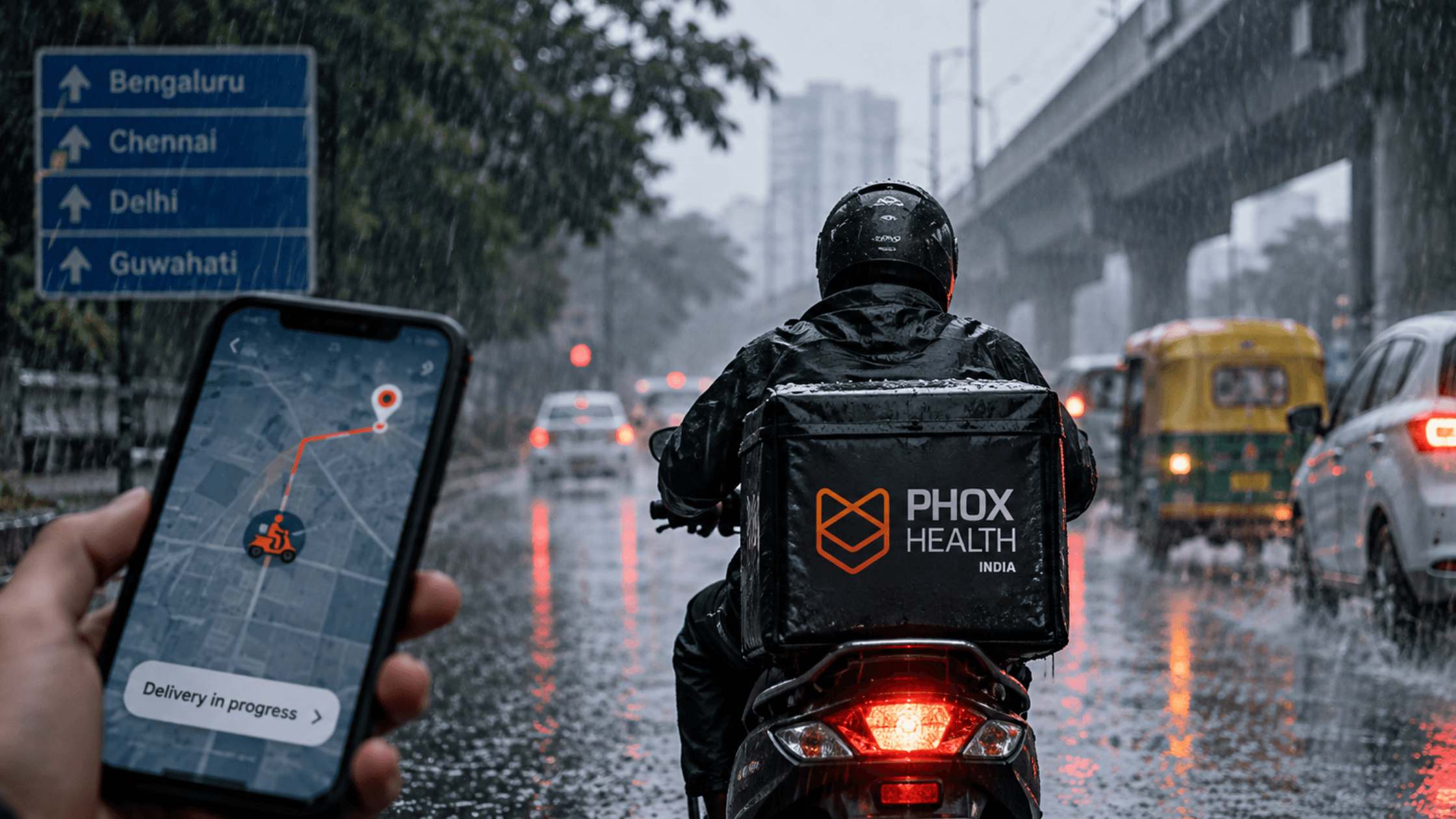
September doesn’t mean monsoon risk is over. In some parts of India, the rains begin to retreat. In others, heavy spells, waterlogging, traffic disruption, and sudden route changes continue to make pharmacy delivery unpredictable.
A delivery that normally takes forty minutes can suddenly take two or three hours. Riders reroute around flooded stretches, wait out downpours, or navigate traffic that barely moves.
For most deliveries, that creates inconvenience.
For temperature-sensitive medication, it creates a much more important question: What happened to the medicine while it was delayed?
A shipment may still arrive. The package may look completely normal. And somewhere in a cool box, on a stalled bike, or in the back of an auto caught in traffic, a batch of insulin or a biologic may be sitting through conditions the pharmacy has limited visibility into.
It may still be within the required temperature range. It may not be.
Without the right monitoring, the pharmacy, the rider, and the patient may have no clear way to know what happened to that medication during the delay.
That is the part of monsoon season that rarely makes it into the weather report: what happens to important medication while the last mile stops moving.
Monsoon Isn’t an Exception. It’s an Operating Condition.
Every pharmacy operations team in India knows the pattern.
Monsoon disruption is not unexpected. It returns every year, even if the exact timing, intensity, and affected routes are harder to predict. Yet many last-mile delivery models are still designed around relatively normal transit conditions.
The problems tend to appear in a few familiar ways:
Waterlogging and traffic turn predictable routes into uncertain ones. A short delivery can become a multi-hour journey depending on rainfall, road closures, congestion, and local conditions.
Limited temperature visibility creates uncertainty for cold-chain shipments. Insulin, biologics, and other temperature-sensitive therapies may require controlled transport conditions. Without temperature monitoring, pharmacy teams may have limited evidence of what happened to a shipment during an extended delay.
Some patients cannot simply “wait until the weather improves.” For patients relying on time-sensitive, specialty, or chronic therapies, delivery delays can affect continuity of care and create unnecessary anxiety.
When something goes wrong, pharmacy teams often find out too late. A missed pickup, delayed rider, incorrect address, or failed handoff may only become visible once the patient calls asking where their medication is.
These are not necessarily failures of individual pharmacies or riders.
They are often the result of delivery systems that were not designed to give healthcare teams enough visibility when conditions change.
What Actually Happens During a Monsoon Delay
Picture a typical cold-chain order caught in a monsoon delay, moving through a standard courier network:
Before the delay: The medication is prepared for transport using an appropriate cold-chain process based on the expected delivery conditions and transit window.
During the delay: Heavy rain causes traffic to build. A road becomes waterlogged. The rider is forced to reroute. The delivery keeps moving, but slowly. The pharmacy may be able to see that the order is “out for delivery,” yet still have limited information about the conditions the package is experiencing while the delay stretches on.
After the delay: The medication reaches the patient. The packaging appears intact. The handoff happens. But without the right monitoring and documentation, the pharmacy may have little objective evidence showing what happened during the most uncertain part of the journey.
This is the gap continuous visibility is built to close.
Not a tracking number that tells you a package moved from point A to point B, but real-time monitoring that tells you what actually happened to it along the way, including the temperature it experienced during exactly the hours it was stuck in floodwater traffic.
Why Continuous Visibility Changes the Response
Monsoon disruption cannot always be prevented, but pharmacy teams can respond very differently when they can see what is happening.
Real-time location visibility allows operations teams to identify a delivery slowing down before the delay becomes a patient complaint, communicate proactively, confirm whether a pickup has happened, and maintain a clearer operational record instead of relying on disconnected calls and messages to reconstruct the journey.
For temperature-sensitive shipments, pairing location visibility with appropriate temperature-monitoring capabilities can also give teams greater insight into whether required transport conditions were maintained.
That changes the conversation from “We think the medicine should be fine” to “Here is what happened during the delivery.” That difference matters in healthcare.
The Real Cost Isn’t Just a Late Delivery
The operational impact of monsoon disruption extends well beyond delivery time. A single delayed prescription can create several downstream problems:
Pharmacy teams spend time calling riders and checking status.
Patients call the pharmacy because they do not know when their medication will arrive.
Operations teams manually investigate exceptions.
Failed deliveries may need to be rescheduled.
Cold-chain shipments may require additional review.
Patient confidence can fall even when the medication eventually arrives.
Multiply that across dozens or hundreds of deliveries during a period of heavy rain, and the problem becomes much bigger than traffic.
It becomes an operations problem and, increasingly, a patient-experience problem.
Monsoon Should Be Planned For, Not Worked Around
Healthcare logistics in India has to account for the environment it operates in. Flooding, extreme heat, humidity, congestion, unpredictable road conditions, and rapidly changing delivery routes are not rare edge cases; they are part of running a last-mile healthcare network here.
The goal is to build a delivery operation that can see disruption early, respond quickly, communicate clearly, and maintain accountability throughout the journey. That is where technology and managed operations need to work together.
At Phox Health, TRAX is designed to give pharmacy teams greater visibility into the last mile, from pickup through patient handoff. When a route slows down, a delivery needs attention, or an exception occurs, teams have greater visibility into what is happening instead of finding out only after the patient calls.
Weather will remain unpredictable. Pharmacy operations don’t have to be.
If your pharmacy is reviewing how it handles prescription delivery, cold-chain workflows, or last-mile exceptions during monsoon season, talk to our team about building a more visible and accountable delivery operation

