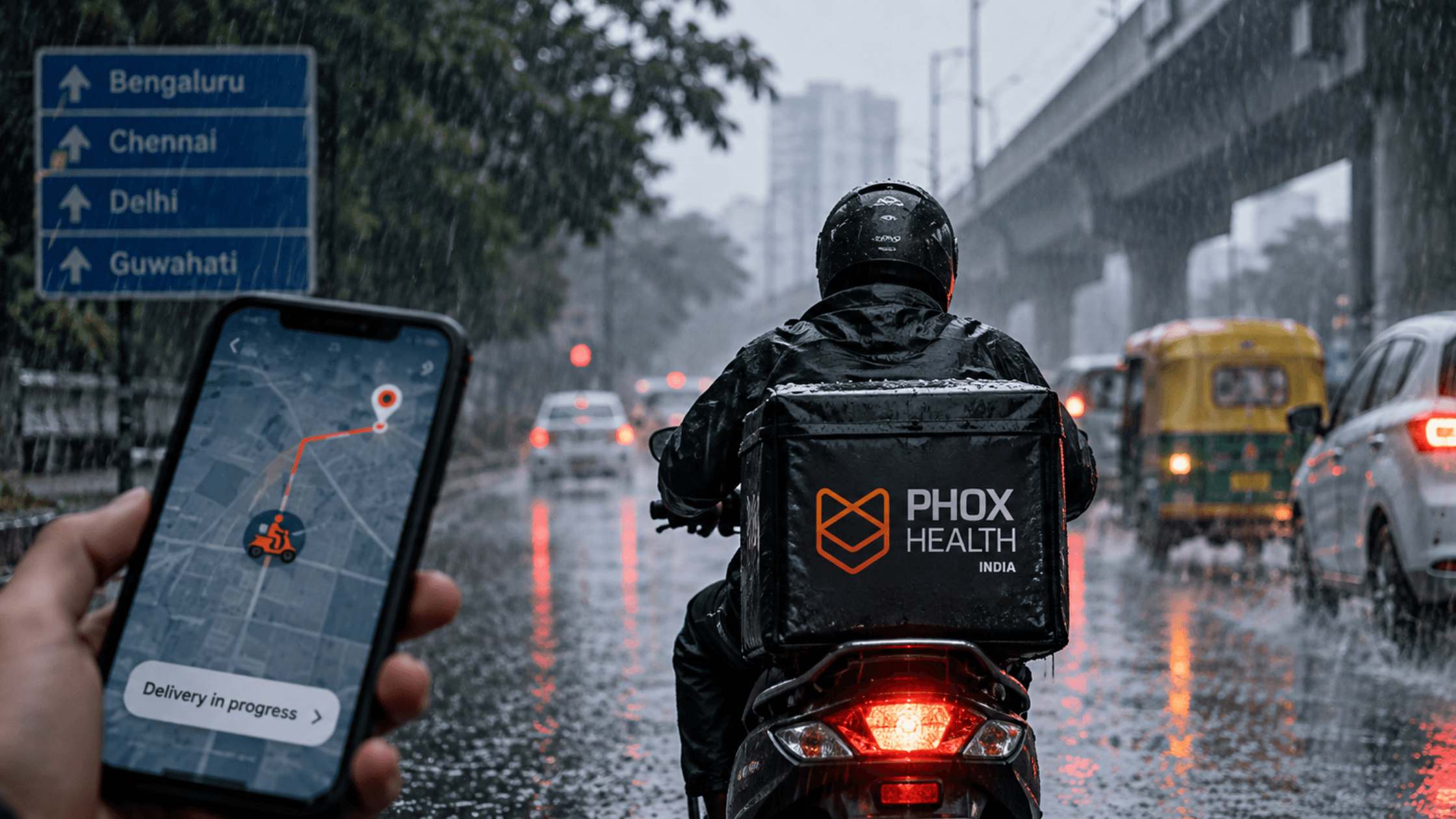
India’s pharmacies have always found a way to get medicines to patients.
An independent chemist may send a trusted delivery person from the neighbourhood. A hospital pharmacy may use different courier partners depending on the area, urgency, or time of day. In some cases, a pharmacy staff member may personally coordinate an important delivery because the patient cannot afford to wait.
These arrangements often work.
But when they do not, the pharmacy is left to manage the consequences.
A rider cannot find the address. The patient is not at home. A gated society does not allow entry. A delivery is delayed in traffic, but no update reaches the family. A temperature-sensitive medicine is left with a security guard or outside the door.
The pharmacy may only learn about the problem when the patient calls:
Has my medicine left the pharmacy?
Who is carrying it?
When will it reach?
At that point, delivery is no longer a transport task. It becomes a pharmacy operations problem.
India’s Pharmacy Last Mile Is Highly Fragmented
India’s pharmacy network is large, trusted, and deeply local. It includes independent medical stores, hospital pharmacies, specialty pharmacies, retail chains, and e-pharmacy platforms.
But the delivery infrastructure behind it remains inconsistent.
The gaps usually appear in four ways:
No visibility after pickup
Once the medicine leaves the counter, pharmacy teams may have no live view of where it is, why it is delayed, or whether the patient has been informed.
Ad-hoc couriers without pharmacy-specific protocols
The same riders delivering food and parcels may also be carrying insulin, antibiotics, or specialty medicines, often without processes designed for healthcare delivery.
Limited temperature accountability
For vaccines, biologics, insulin, and other temperature-sensitive medicines, many local delivery networks cannot provide a clear record of how the medicine was handled during transit.
No dependable delivery arm to compete with e-pharmacies
Independent and hospital pharmacies are expected to offer the same convenience as online platforms, but often without reliable logistics infrastructure of their own.
For pharmacy teams, these gaps make it difficult to maintain consistent standards, document every handoff, manage exceptions, and protect the patient experience.
The issue is not a lack of effort from pharmacies. It is the absence of dedicated last-mile infrastructure built around the needs of medicine delivery.
When that infrastructure is missing, accountability can quietly disappear after the medicine leaves the counter, and the patient is often the one left carrying the risk.
Medicine Delivery Requires More Than Convenience
Indian patients increasingly expect medicines to arrive at home with the same ease as groceries and other everyday purchases.
But medicine is not an ordinary parcel.
A delayed food order is frustrating. A missed or mishandled medicine delivery can affect treatment, patient confidence, and the pharmacy’s relationship with the family.
A medicine may reach the correct building and still be at risk if it is left at the gate, handed to the wrong person, kept in a rider’s bag for too long, or exposed to Delhi heat, Chennai humidity, Bengaluru traffic, or Guwahati rain.
Independent and hospital pharmacies already have something valuable: patient trust.
Patients know their local chemist. Families return to the same hospital pharmacy. Pharmacy teams understand why a prescription is urgent.
The challenge is extending that trust beyond the counter.
Pharmacies need a delivery model that offers convenience without compromising care, reliability, or responsibility.
Built in the U.S. since 2020. Now built for India.
Phox Health has been solving exactly this problem since 2020 in the United States, building dedicated pharmacy logistics infrastructure instead of retrofitting general courier networks for medicine. The lesson from that work is simple: pharmacy delivery isn't a smaller version of e-commerce delivery. It's a different discipline, with different failure modes, and it needs its own tools.
That's the model we're bringing to India, through two connected pieces:
PhoxOS is the software layer: the system that gives a pharmacy real visibility into every order, every handoff, and every delivery outcome, instead of a black box after the packet leaves the counter.
TRAX is the delivery layer: a directly managed fleet built specifically for pharmaceutical delivery, not a marketplace of third-party riders bidding on jobs. That distinction matters. An aggregator optimizes for coverage. A managed network can optimize for accountability.
Together, PhoxOS and TRAX aren't "another courier app for pharmacies." They're infrastructure, the kind India's pharmacy last-mile has never had.
Four Principles Guiding Phox Health India
As we bring this model into Indian pharmacies, four operating principles are non-negotiable:
Transparency: Pharmacy teams and patients should be able to see what is happening throughout the delivery journey.
Accountable handoffs: Every pickup, transfer, delivery attempt, exception, and final handover should have clear ownership.
Sustainable cold-chain: Temperature-sensitive medicines need practical, reusable systems that help protect the medicine while reducing unnecessary packaging waste.
Patient experience: Patients and their families should receive timely updates and support without every delivery question coming back to the pharmacy counter.
These aren't slogans. They're the design constraints behind every decision we're making as we build out the network city by city.
Already Operating in India
Phox India is headquartered in Bengaluru, and we're already operating in Delhi, Chennai, Bengaluru, and Guwahati, not as a pilot, and not as a someday plan, but as a live network today.
If you run a hospital pharmacy or an independent chemist counter in any of these cities, the question worth sitting with is simple: when a prescription leaves your counter, do you actually know what happens next?
We think it is time pharmacies got a second opinion on logistics.
In the coming weeks, we will go deeper into how PhoxOS and TRAX work in practice. For now, consider this the introduction.
If your pharmacy is facing gaps in visibility, handoffs, cold-chain delivery, or patient communication, reach out to our team to start a conversation.